Override: Breach Protocol
OVERRIDE // Breach Protocol
A fictional network-intrusion campaign, played entirely through a terminal.
The Premise
The city runs on the LATTICE — a sprawling, semi-autonomous network stitched into everything: home routers, corner-store point-of-sale systems, hospital records, power substations, traffic AI, orbital satellites, and eventually a central cognition engine that quietly coordinates all of it. Nobody voted on this. Nobody reads the terms of service. It just runs the city now.
You have a backdoor into it. What you do with that access — clean, contracted, and careful, or fast, loud, and uninvited — is entirely up to you.
OVERRIDE is a single-player browser and desktop game about breaking into that network, one location at a time, using nothing but a command-line terminal, a detection meter you're always one mistake from maxing out, and whatever nerve you've got left.
Two Ways to Play
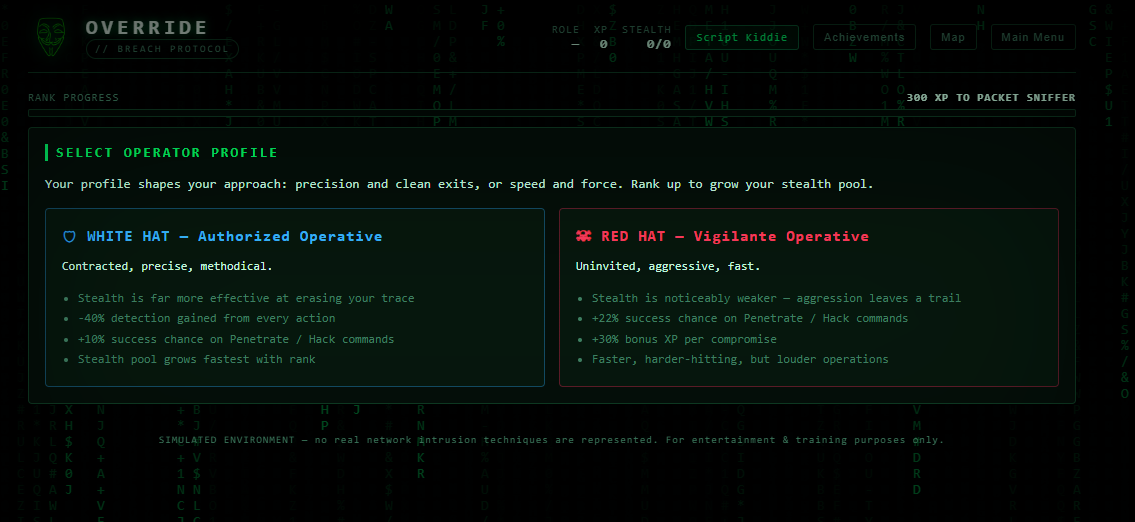
Before the first mission, you pick an identity that shapes every number in the game:
- White Hat — Authorized Operative. Contracted, methodical, careful. Every action generates far less heat (‑40% detection), techniques succeed more reliably, and Stealth is dramatically more effective at scrubbing your trace. You leave almost no footprint — but you're also playing it straight.
- Red Hat — Vigilante Operative. Uninvited, aggressive, fast. Bigger success bonuses and bigger XP payouts on every compromise, but you run hotter — detection builds faster and Stealth does less for you. You hit harder and get richer faster, at the cost of being easier to catch.
Both roles level up through the same 15-rank ladder (Script Kiddie all the way to MasterHacker), and both grow their Stealth charge pool by +1 with every rank gained — starting from different bases (20 for White Hat, 15 for Red Hat), so the roles stay meaningfully different without one permanently running away from the other as you progress.
The Core Loop
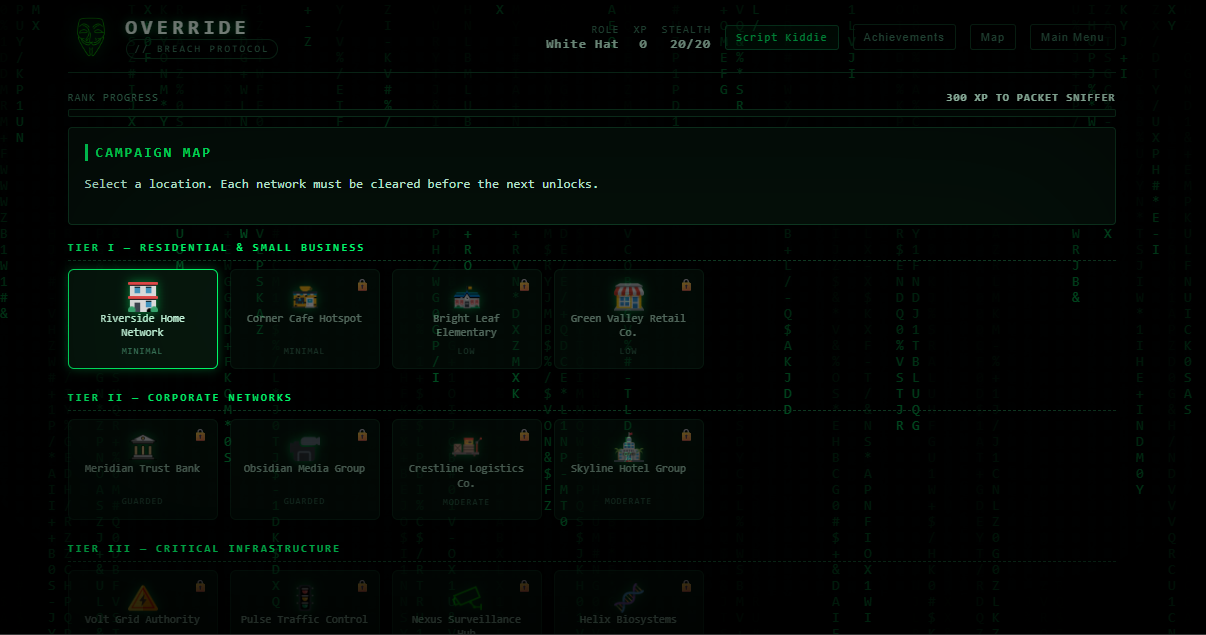
Every location is a small network of nodes — a firewall, a router, a database, sometimes an AI core — that have to be breached in order. You can't skip ahead to the juicy target; you pivot deeper one system at a time. For each node, the loop is:
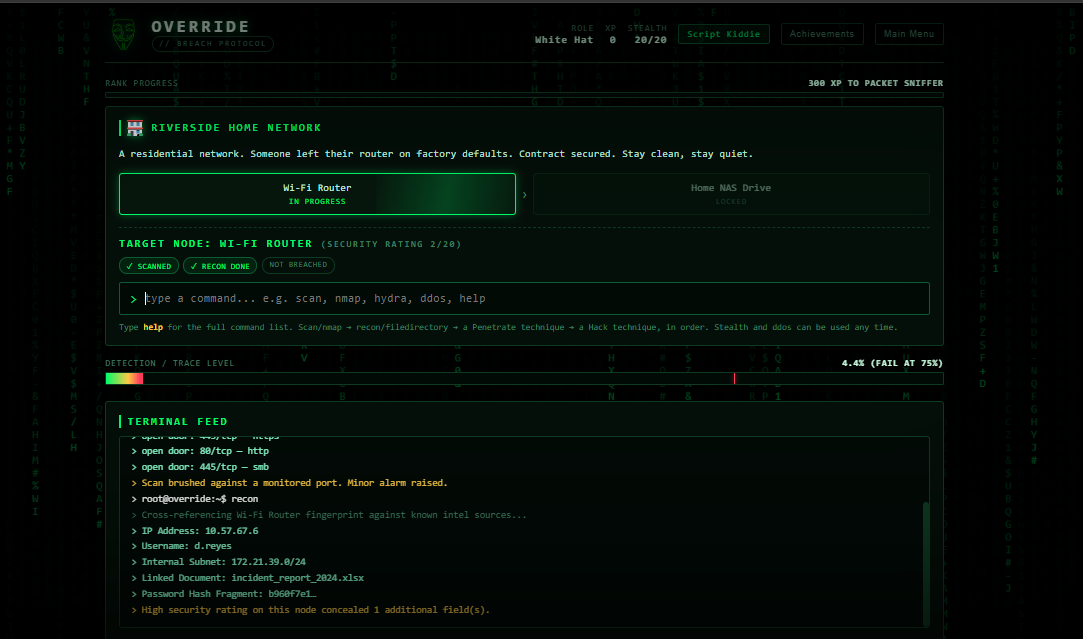
- Scan it to find open ports and, sometimes, exposed public documents.
- Recon it to pull real intel — IP addresses, usernames, subnet ranges, linked documents, password hash fragments, session tokens — though a well-secured target will only ever give up part of that picture.
- Penetrate it using one of eight named techniques to establish a foothold.
- Hack the terminal using a social-engineering or payload-based technique to fully compromise it and move on.
There's no button-mashing here — every one of those steps is typed into an in-game Access Terminal. Type help and it lists exactly what's available; type something it doesn't recognize and it tells you so, the same way a real shell would. A few extra tools sit alongside the core loop for players who want more texture: nmap for a deeper scan, filedirectory to brute-force hidden paths, ddos to knock a target's defenses down temporarily at a steep detection cost, and kalisuite to run a fast combined scan-and-recon pass. The eight Penetrate techniques and five Hack techniques all carry names familiar to anyone who's poked around cybersecurity culture — brute force, SQL injection, session hijacking, Hydra, Medusa, Metasploit, phishing, rootkits, trojans — but they're gameplay abstractions, not tutorials; nothing here is a real working exploit.
The Real Enemy: Your Own Trace Level
Every action — successful or not — pushes your Detection meter up. Scanning a heavily-monitored node, botching a brute-force attempt, or deploying a loud payload all add heat. So does time itself: passive IDS sweeps quietly tick the meter upward in the background whether you're doing anything risky or not. Stealth is your only way to claw it back down, and it's a limited resource — once your charges for a location are spent, they're spent. Cross 75% detection and the operation ends immediately: connection traced, countermeasures locked you out, mission over. It's the one number in the whole game you're always watching.
Leave a comment
Log in with itch.io to leave a comment.